
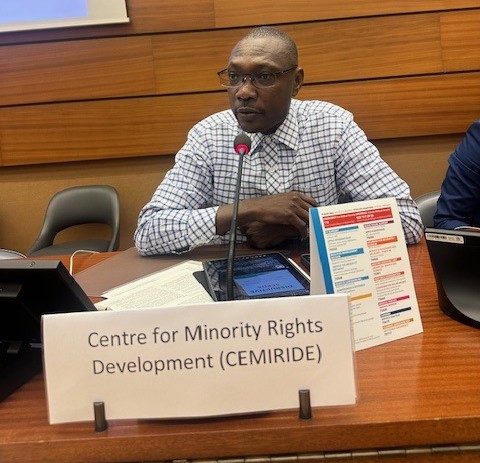
From February 17 to 21, 2025, Mr. Nyangori Ohenjo, representing the Centre for Minority Rights Development (CEMIRIDE) in Kenya, came to Geneva to engage in advocacy prior to the UPR session of Kenya, scheduled for May 2025. During his visit, he took part in bilateral meetings with several State representatives and UN staff, and delivered speeches at the UPR Info pre-session of Kenya and at the EU Delegation’s informal meeting with NGOs, advocating for minorities and indigenous people’s rights.
Earlier in 2024, at the request of FastenAktion, the CCIG had delivered two online training on the UPR mechanism for about 30 Kenyan local actors, including CEMIRIDE, focusing on civil society participation and drafting UPR submissions. This space allowed the participants to engage with each other and begin coordinating their potential participation at the 49th UPR pre-session.
With the technical support of CCIG and FastenAktion, the CEMIRIDE representative effectively presented Kenya’s current human rights situation vis-à-vis other Member States. Beginning with UPR submission prepared jointly with other local partners, and continuing through his interventions in Geneva. Mr. Nyangori Ohenjo highlighted challenges and areas for reform related to the right to food, access to land, and minority groups. He also received personalized and careful feedback to deliver impactful speeches while prioritizing human rights issues and the respective recommendations.
He began his advocacy in Geneva by participating as a speaker in the UPR Info pre-session and then in the European Union delegation’s informal meeting with NGOs ahead of UPR49 to encourage Member States to address specific recommendations to Kenya. Following this, he took part in several bilateral meetings with the Permanent Missions of Colombia, Switzerland, Georgia, France, Spain, Chile and Bolivia.
Among other things, the CEMIRIDE representative recommended ensuring the right to food in Kenya by securing land access through the enforcement of existing land laws, and to effectively protect land rights for peasants, with particular attention to women, youth, and people with disabilities. Additionally, he urged to implement safeguards against arbitrary evictions in accordance with the National Action Plan on Business and Human Rights.
This visit to Geneva not only gave Mr. Ohenjo an opportunity to raise awareness on Kenya’s issues and share his recommendations, but also allowed the small delegation accompanying him to attend parallel sessions, listen to the panels on international issues, and connect with advocates from other countries.
This experience illustrates how capacity-building efforts, such as CCIG’s training on the UPR mechanism, could directly strengthen civil society engagement in international human rights spaces, and amplify local voices and recommendations at the Universal Periodic Review of their respective countries .
For more information, please consult relevant UPR Submission and Executive Summary.