
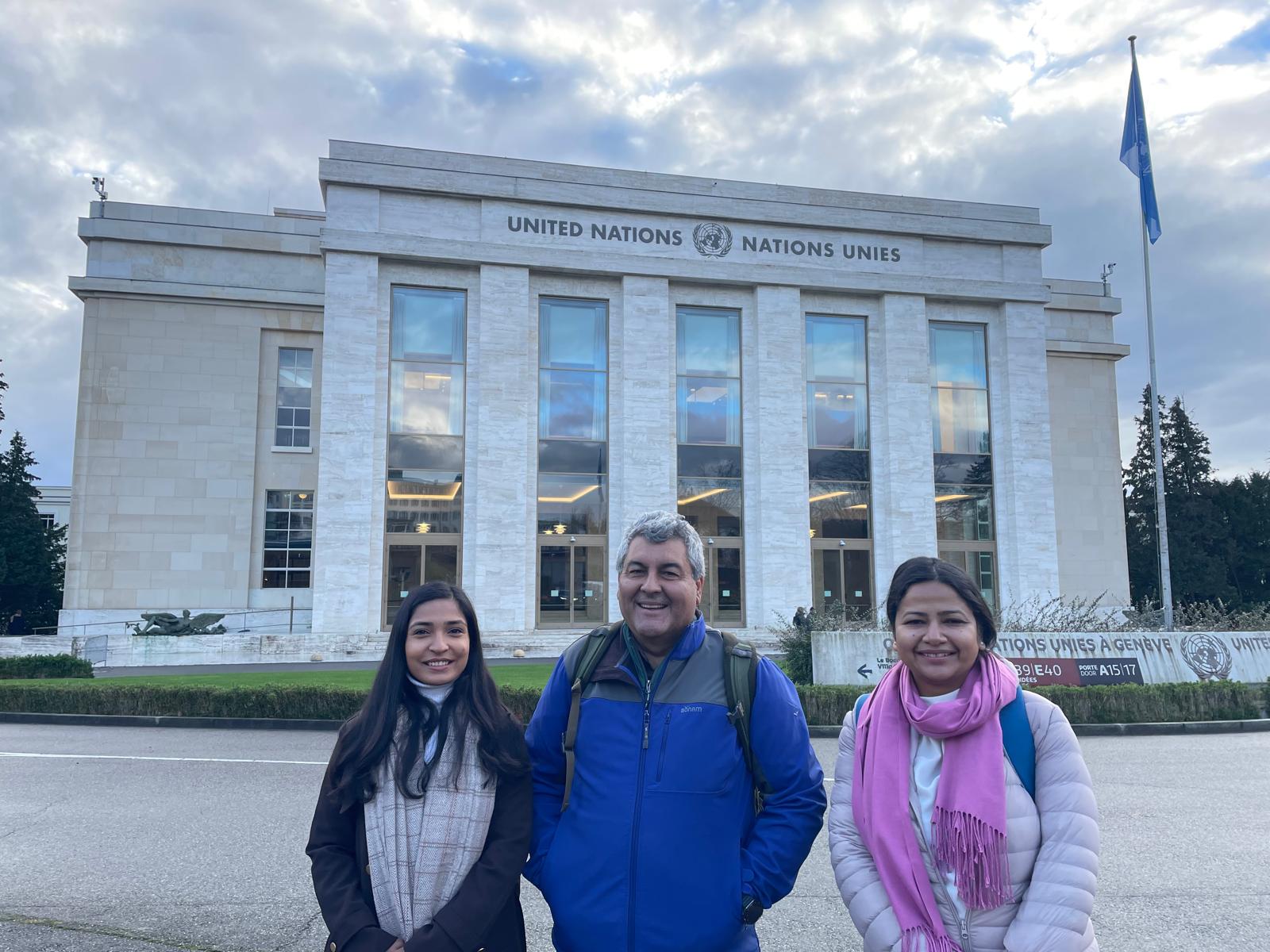
From November 25 to 28, three Nepali civil society actors representing the local organizations of Community Self-Reliance Centre (CSRC) and Social Work Institute (SWI) came to Geneva to engage in advocacy prior to the UPR session of Nepal, which is scheduled for January 2026. During their visit, they took part in bilateral meetings with several State representatives, delivered a speech at the EU Delegation’s informal meeting with NGOs, and attended the UPR Info pre-session of Nepal.
These advocacy actions supported by CCIG, FastenAktion and DKA Austria, followed the series of online training delivered by CCIG to local partners from June to October, in order to ensure their meaningful participation in the UPR process and allow them to effectively present Nepal’s current human rights situation vis-à-vis other Member States. Beginning with UPR submissions prepared jointly with other local partners, and continuing through their interventions in Geneva, CSRC and SWI representatives highlighted challenges and areas for reform related to the right to food, access to land, and minority groups. The specific situation of women and youth in rural areas was also brought to the attention of relevant stakeholders.
Prior to and upon their arrival in Geneva, CSRC and SWI representatives received personalized and careful feedback by CCIG, FastenAktion and DKA Austria to deliver impactful speeches while prevailing their priority human rights issues and the respective recommendations.
They began their advocacy in Geneva by participating in the European Union delegation’s informal meeting with NGOs ahead of UPR51 to encourage EU Member States to address specific recommendations to Nepal. During the discussion, Aparajita Gautam, from CSRC, urged EU Member States to uphold zero discrimination in land allocation, require women’s representation in land-governance bodies, and protect tenure rights and food security in accordance with the United Nations Declaration on the Rights of Peasants and Other People Working in Rural Areas (UNDROP). Meanwhile, Namaraj Silwal, from SWI, emphasized the need to fully implement the Right to Food Act, ensure peasants’ involvement in shaping food and agriculture policies, strengthen social protection for farmers, support local markets, and enhance climate resilience.
Following this, they also took part in several bilateral meetings with the Permanent Missions of Colombia, Austria, Romania, South Africa, Belgium, and Italy. These exchanges allowed civil society actors to share the main human rights issues faced in their communities, present key recommendations to address them, and clarify questions raised by the missions’ representatives. Their interventions focused on advancing recommendations related to the human rights to food, land, and the protection of minority groups, with these meetings providing a valuable space for dialogue and the exchange of perspectives.
Additionally, the Nepali representatives had the opportunity to attend the UPR Info 51st pre-session. There, they were able to hear other key human rights concerns and recommendations related to their country presented by Nepali civil society organizations and national human rights institutions. The pre-session also offered a space to interact with other actors, exchange ideas about their work, and explore potential avenues for strategic collaboration.
Finally, they met with OHCHR officers working for the implementation of UNDROP. During this meeting, they highlighted the multiple challenges Nepali peasants continue to face, including a fragmented policy framework, limited access to resources, inequitable social services, and persistent economic insecurity. These realities underscore the urgent need for Nepal to fully implement the principles of UNDROP, and the meeting provided an opportunity to raise these concerns and explore concrete measures for stronger national follow-up.
We are proud to have accompanied Nepali civil society representatives throughout their time in Geneva and look forward to seeing how they bring these insights back to their communities to continue carrying out their human rights advocacy work with local communities in Nepal.
UPR Submissions available here: CSRC and SWI.
Executive Summaries available here: CSRC and SWI.
For information on a similar activity for Kenya, read here.