
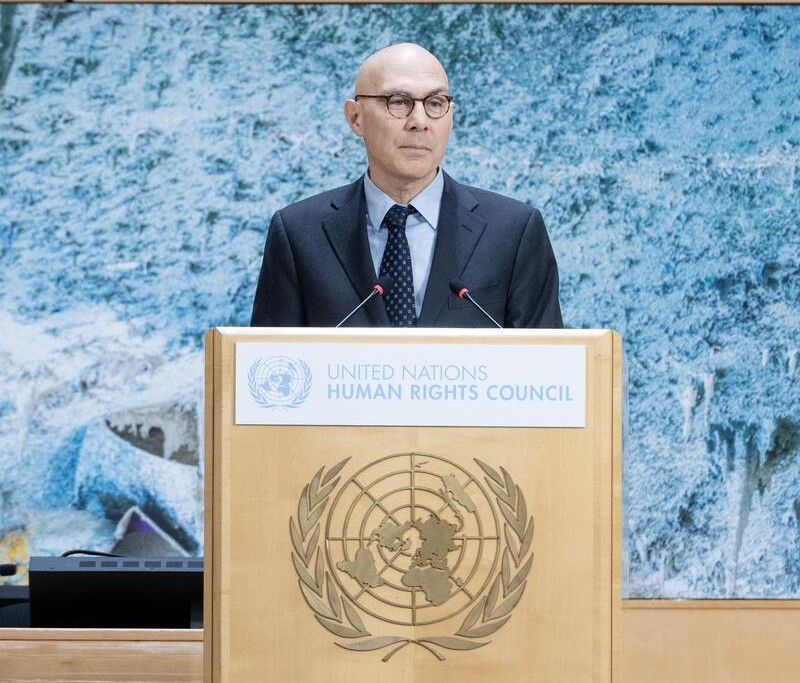
“The world is upside down – we all feel it.
Discussions on power are everywhere: who has power; how power is shifting; how power will evolve.
Players compete for control over land, energy, attention.
But to what end?
Dominating the global economy? Accumulating more power? Putting AI into space?
Surely power must serve other purposes.
If you ask people around the world what they want from power, the answers are the same: peace, safety, a decent standard of living.
In short, people desperately want their human rights.”
Volker Türk, United Nations High Commissioner for Human Rights
At the 61st Session of the UN Human Rights Council
The UN Human Rights Council held its 61st session from February 23rd to March 31st 2026. Topics discussed include the right to food, the rights of persons with disabilities, the rights of the child, the right to a healthy environment, linkages between human rights and a culture of peace, and the violations of international humanitarian law within several countries. Concurrently, the rise of authoritarian tendencies worldwide, reflected in the outbreak of new conflicts or the escalation of existing ones, has contributed to the tense political climate in which this session of the Human Rights Council took place.
Increases in armed conflict and attacks on international institutions constitute two of the issues raised in the global update delivered by UN High Commissioner Volker Türk, during the first week of the HRC session. According to the High Commissioner, instances of armed conflict have doubled since 2010, along with a ⅓ increase in attacks on civilians. “It is baffling that political leaders are not taking urgent steps to reverse these trends,” said Mr. Türk. And he warned: “We must not revert to violence as an organising principle.”
Even worse, Mr. Türk stated that some political leaders are “attacking the institutions designed to keep us safe –the United Nations, including the International Court of Justice; the International Criminal Court; this Council, and its mechanisms.”
“[…] The pattern is clear: ignoring atrocity crimes fuels greater bloodshed. The world cannot stand by as the edifice of international humanitarian and human rights law is dismantled before our eyes. States, in fact everyone, needs to stand up for universalism, and against a descent into competing narratives and historical allegiances. That starts with recording and analyzing the facts, and applying the same rigorous standards to everyone without exception.” – he added.
In response to these different conflicts, the High Commissioner calls for some clear actions: banning weapons sale or transfer where there is a risk they could be used to violate international law; ending hate speech and dehumanizing rhetoric; ensuring accountability through credible investigations and prosecutions, and implementing human rights confidence-building measures to help create the political space for dialogue and peacebuilding.
In this context, CCIG shares the concerns of the UN High Commissioner that “Disrespect for international law is echoed in disrespect for human rights at the national level.” Thus, the CCIG wishes to reaffirm its commitment to prioritize human rights implementation in accordance with international law and in consultation with affected local populations. Accordingly, in conjunction with the 61st HRC session, the CCIG put forth a joint statement on behalf of 17 NGOs, reiterating the relevance of the UPR as an international mechanism that delivers results and fosters dialogue and cooperation among all stakeholders, especially at a time when multilateralism is being questioned. Human dignity, equality and non-discrimination must remain at the heart of this engagement. (For more information, click here).
CCIG’s mission remains focused on raising human rights awareness and facilitating capacity building for local civil society actors, so as to empower them to share their human rights concerns and actively engage in human rights monitoring and follow up in their own communities.
“The final move in the authoritarian playbook is persuading people that they are powerless.
But human rights remind us that we are not.
Our choices, our voices, our votes determine what comes next. The future depends on each of us.”
To read the full global update by the UN High Commissioner for Human Rights, click here.
To find out more about CCIG capacity building activities, click here.